
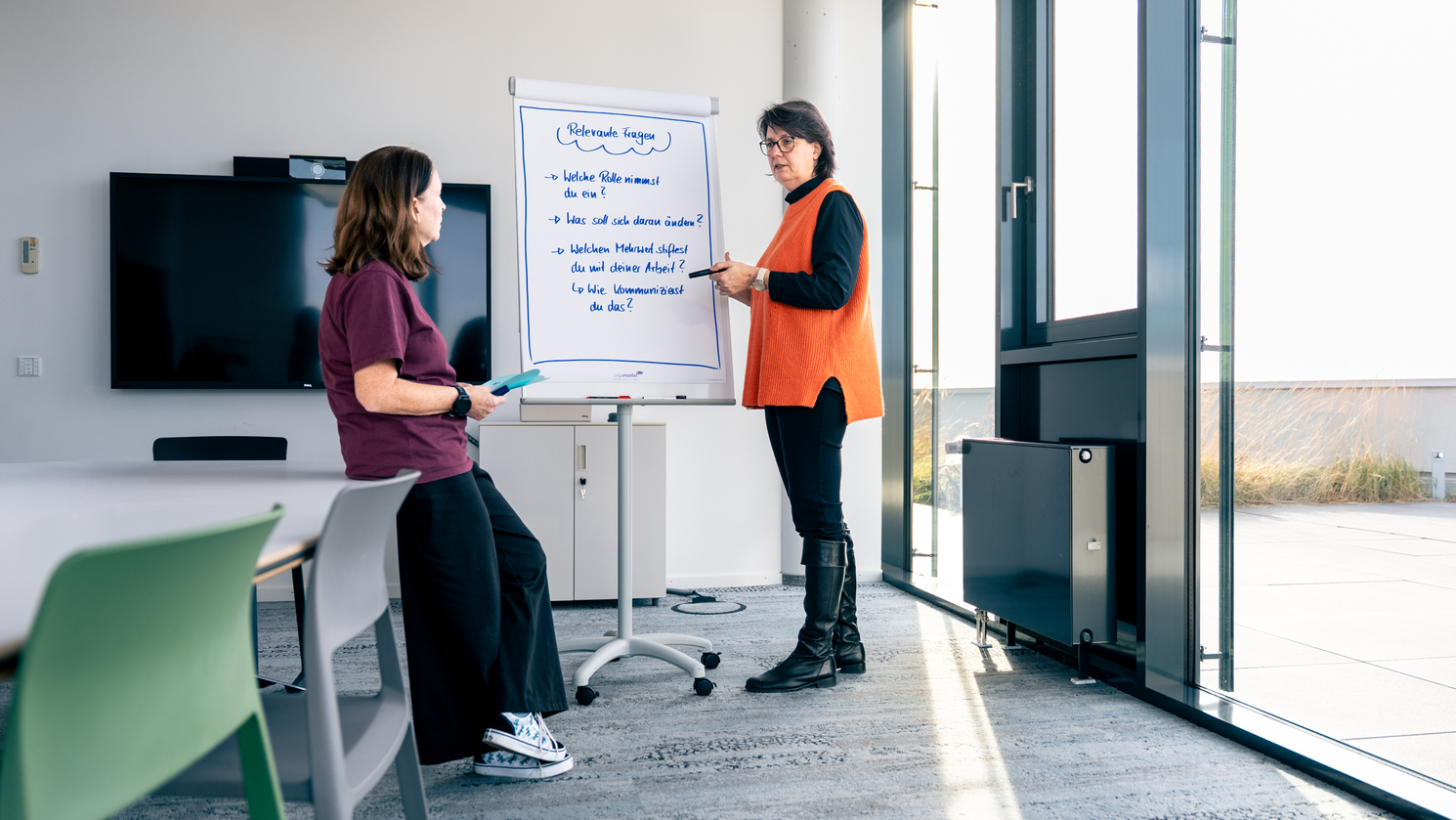
As Haufe Group, we can only stay future-ready if our employees don’t just cope with change but help shape it. That’s why we developed “Discover the Future – your Future Skill Journey.” This six-month learning program doesn’t explain the future, it makes it something you can learn. It supports the personal development of our colleagues and helps them reflect on their role in change, choose an individual Future Skill, and anchor it step by step in their daily work.
Change is in our DNA — and it drives us forward.
Explore our story of continuous transformation.
The future doesn’t start on an explicit date. It always starts when you stop reacting and start deciding – and thus consciously shaping what comes next. Sometimes you only feel that when you find yourself in a situation where every decision is possible, and you still don’t know which way to go.
That’s how it was for Simone Roth. It was a Wednesday in March 2025, just before lunch, and she was standing in a bright meeting room together with 15 other Haufe Group colleagues. Two axes were taped to the floor in front of her, along which everyone was supposed to position themselves. The task: How do you assess your own future and your personal influence on it? The options: somewhere between pessimistic and optimistic, between actively shaping and having no influence. A classic workshop method called the Polak Game, designed to make ideas about the future visible – and sometimes your own uncertainty, too. “Everyone else had picked a spot in the room and I was just standing there thinking: So what’s my room to move? And I had no answer. That felt really uncomfortable,” Simone says today, six months later, laughing a little at herself. In the end, she placed herself right at the zero point. “It was a bumpy start to what turned into a pretty successful journey.”
Self-assessment with the Future Skills Compass
The journey has a name: “Discover the Future – your Future Skill Journey.” It’s a learning program launched by Haufe Group in 2025, in which participating employees explore future competencies – the so-called Future Skills. The term describes the abilities people need to remain capable of acting in a working world shaped at the same time by digitalization, automation, artificial intelligence, climate change, and complex markets.
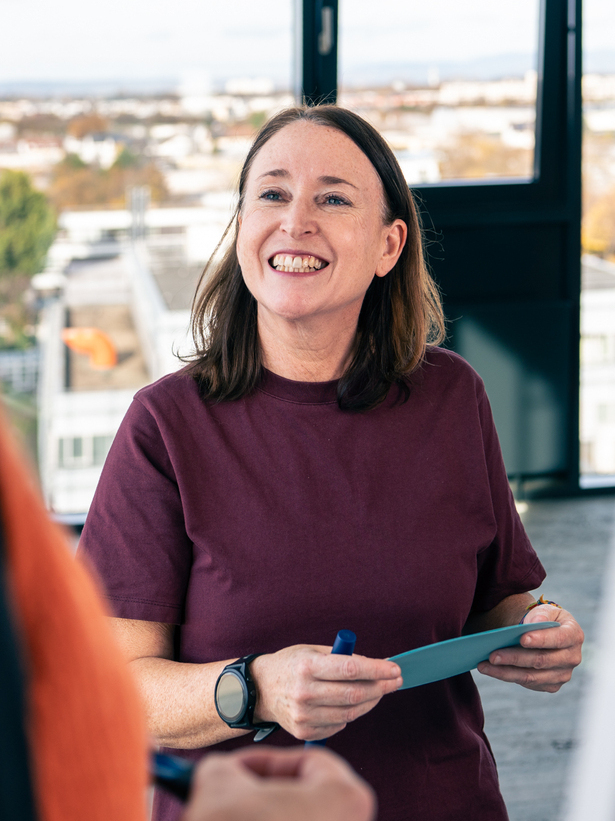
Simone had never heard of Future Skills before, but she was curious to look into her future. “I had seen a news post about the program on our intranet and thought: If not now, when?” She signed up and started, like everyone else, with a self-assessment: the Future Skills Compass from the university Duale Hochschule Baden-Wuerttemberg. Simone had to imagine herself in a wide range of situations and consider how well she could handle the challenges described. In the end, a spider chart emerged, showing several strengths but also a few weaker areas. One stood out clearly for her: self-efficacy.
Why that particular skill? Her role gives the best answer. “Well,” Simone begins and laughs. “I’m a Business Operations Manager and responsible for our brand Lexware within Haufe Group.” And because she knows that her job title doesn’t explain much, she keeps going, describing how she connects processes between product, marketing, and customer service, where things get stuck, which interfaces she closes, which workflows she rebuilds. As Simone talks about processes, her face lights up. Where others mentally check out after a few seconds, she gets into full flow. “Processes are so exciting because we can move so much.”
Simone’s dilemma: she’s not a chimney sweeper. No one instantly has a picture in their mind of what exactly she does and why she’s needed – and at the beginning, she didn’t either. “We move a lot in organizations, but it’s hardly visible. Many people don’t even know we exist or that we could help them. And yet we’re such an important link in a huge process chain. I’ve always wanted to make that more visible, including for myself.”
How future-readiness thakes shape in practice
Simone is not alone in this. In today’s working world, job roles are becoming increasingly complex and multi-layered. For Mira Vanessa Gampp, who is responsible for the program, the goal was therefore always clear: “I didn’t just want to strengthen individual skills – I wanted our employees to reflect on their attitude toward the future. Does the future just happen to me, or do I shape it?” she says. “As Haufe Group, we can only be as future-ready as our people.”

Mira is an organizational and people development specialist in Haufe Group’s HR Learning & Development team and developed the program together with Antje Massa, who heads internal development programs at our brand Haufe Akademie. They bring different perspectives: Mira is a design thinking and systemic coach and has worked with futures research and human-centered innovation throughout her career. Antje studied business education, worked as a sales trainer, built an in-house academy, and brings didactics and decades of experience.
Together, they created a framework that offers orientation but no ready-made solutions. “There are so many Future Skills – who needs which one? For us it was clear from the beginning that we can’t decide that for our colleagues,” Mira says. “Instead, we wanted to create a space where you can ask yourself the right questions.”
Change is in our DNA — and it drives us forward.
Explore our story of continuous transformation.
HR Excellence Awards 2025 – Shortlist in the Learning & Development category
The program has convinced not only us and our colleagues but also the expert jury of the HR Excellence Awards. In 2025, “Discover the Future – your Future Skill Journey” made it onto the shortlist in the Learning & Development category. The program was nominated because it doesn’t just teach Future Skills but anchors them in the everyday work of our employees. It combines personal reflection, individual learning paths, and concrete application – making future-readiness something people can actually experience.
The program runs over six months and follows a clear structure: self-assessment, kick-off, two extended learning phases within day-to-day work, and a joint closing session. The kick-off is deliberately intense and personal. Trend cards, future personas, or a taboo game with the Future Skills get people thinking about the future and their own competencies before they choose a skill. “Everyone gets a large A3 sheet and has to write down: Which skill do I want to learn? And how do I learn best? Thanks to our brands Haufe and Haufe Akademie and our broad internal learning offering, there are many options – books, e-books, trainings, coaching, seminars. For every skill there is a curated collection in our Haufe Group learning world,” Antje explains.
There is also a mandatory learning partnership, ideally with another participant from the group or with colleagues from one’s own network. “We basically see learning partners as a kind of moral compass,” Antje says with a wink. “They challenge you and push you to stay on it.”

After this kick-off comes the self-directed learning phase. “We rely completely on personal responsibility,” Antje says. “At the mid-point check-in, we often hear the same things: everyday work was so full, I didn’t get as far as I planned. We always stress: You’re doing this voluntarily. You set your own priorities.” Of course, there are also participants who don’t really get into action. “We still believe that important impulses remain, even if people only integrate them into their working life later.”
What Future Skills change
Everyone takes something away. For Tobias Pieper, it was the insight that future-readiness doesn’t mean learning something completely new, but looking at things differently. He has worked at Haufe Group for more than twenty years and is now Senior Marketing Manager for trade fairs and events at our brand Haufe. “I’m somewhere between project steering and coaching, with an eye on the big picture and the details at the same time,” he says.
Throughout his career, he has regularly questioned himself and expanded his skill set. “I was curious whether there was still something I was missing.” When Tobias filled out the Future Skills Compass, much of it confirmed what he already knew about himself. But one skill stood out: sensemaking. “It was the least developed. I couldn’t really grasp it and wanted to take a closer look.” So he started researching. “I poked our internal HG.gpt, asked colleagues, watched TED Talks, and read a lot.”
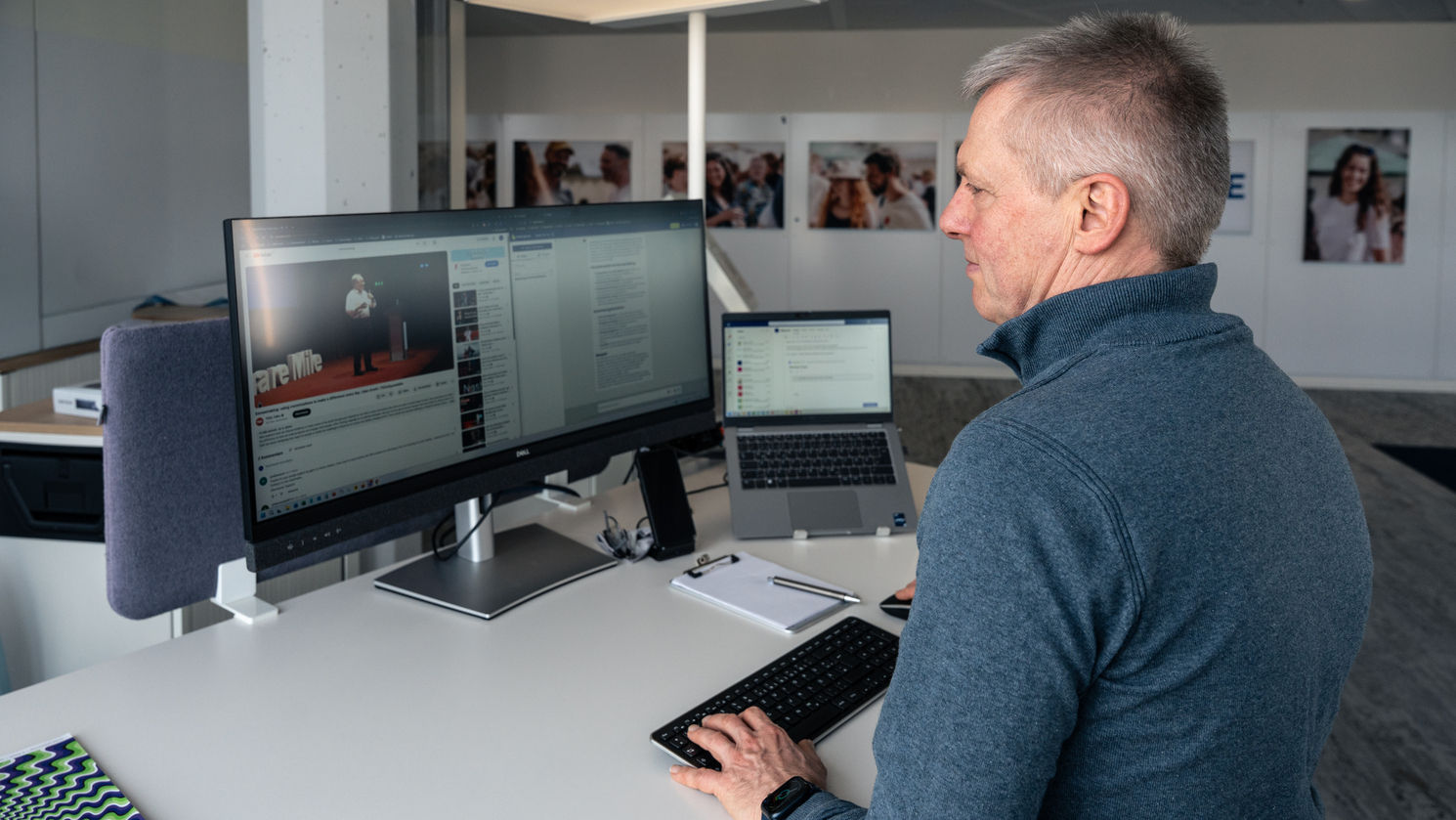
What he found was that sensemaking actually has quite a lot to do with his job: he often finds himself in situations where everything is happening at once. Target-group marketers, product owners, the events team, external organizers – all with their own expectations, priorities, and timelines. “The people I work with have different goals and perspectives. My task is to shape a shared understanding that works for everyone. That’s exactly what sensemaking is.”
During his research, he came across a method that is anything but new – in fact, quite old. “Mind mapping,” Tobias says, smiling. “I used to do that all the time and then forgot about it.” Today, when multiple demands hit him at once, he writes everything down – digitally in the MindManager tool instead of drawing bubbles and lines on paper. Through the program, Tobias didn’t discover a completely new skill set, but awareness.
Change is in our DNA — and it drives us forward.
Explore our story of continuous transformation.